A research-backed executive function curriculum, delivered in a student planner.
Eight EF skills taught and practiced across the school year on the student's own assignments. Designed by a PhD with 15+ years in education and a specialty in neurodiverse learners. Run it as a counselor small group, an advisory curriculum, or campus-wide.
You already bought the planners.
You already have the advisory period.
But neither one teaches them how to plan.
This isn't a new initiative competing for a slot in the master schedule. It's the ten minutes you already scheduled, the teacher already standing in the room, and a planner with the lesson printed inside it.
It costs more than a blank planner.
A blank planner is paper. This is a full-year executive-function curriculum, a set of planning tools, and a digital hub with student instruction and staff support — delivered in the one object students already carry to every class.
Compare it to what an EF intervention actually costs — a program license, a consultant, a staff position. Then compare who it reaches: every student in the building, not just the ones on a caseload.
It usually isn't a motivation problem.
The student who does the work and never submits it, the one who starts the project the night before, the one whose IEP goal says "will use organizational strategies" with no tool attached — that's executive function, and it is teachable.
A small group you don't have to build
A full-year scope and sequence for procrastination, organization and time-management groups. Every session has a page, an activity and a takeaway — documentable practice for 504 and IEP goals naming organization, task initiation or self-advocacy.
Curriculum for the advisory period
One EF skill a week, 10 minutes, taught on the assignments students already have. No prep and no photocopying — the instruction is printed on the page, so a teacher can pick it up cold. PD available if you want to go deeper.
One shared system, one shared language
Every student on the same routine, every teacher using the same words for prioritizing, planning and Plan B. Progress is visible in the numbers you already track: missing assignments, late work, and how often students email a teacher themselves.
MTSS-friendly by design
Tier 1 as a campus-wide planner and advisory routine. Tier 2 as a counselor-led small group for students who keep turning work in late or not at all. Tier 3 alongside a case manager for students with 504 plans and IEPs whose goals name executive-function skills. Same tool, three intensities — so the student in a group isn't carrying a different book than everyone else.

Both are planners.
Only one teaches how to plan.
If your campus already issues a planner, this is the comparison to bring to the table. Same shelf, same price range, entirely different job.
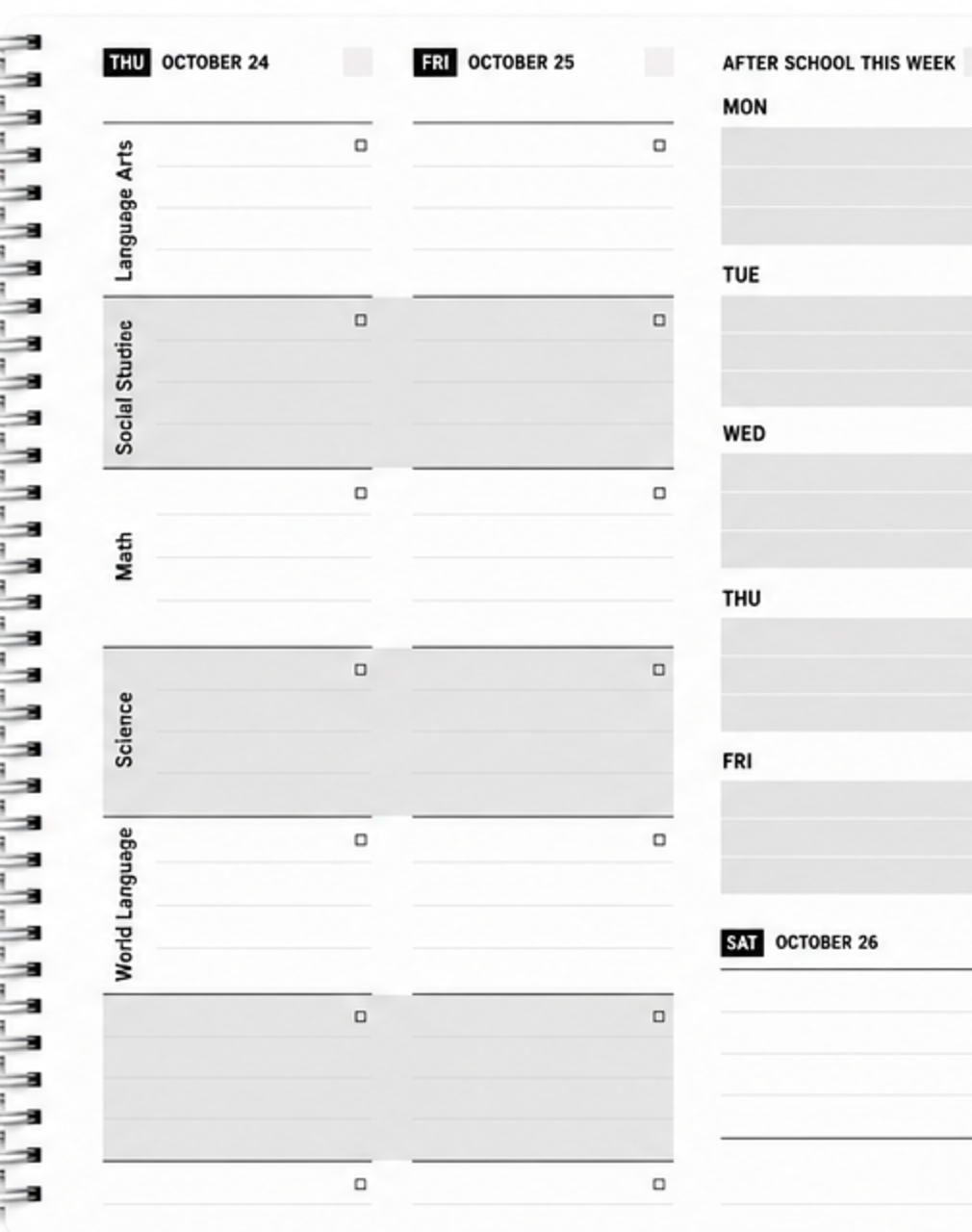
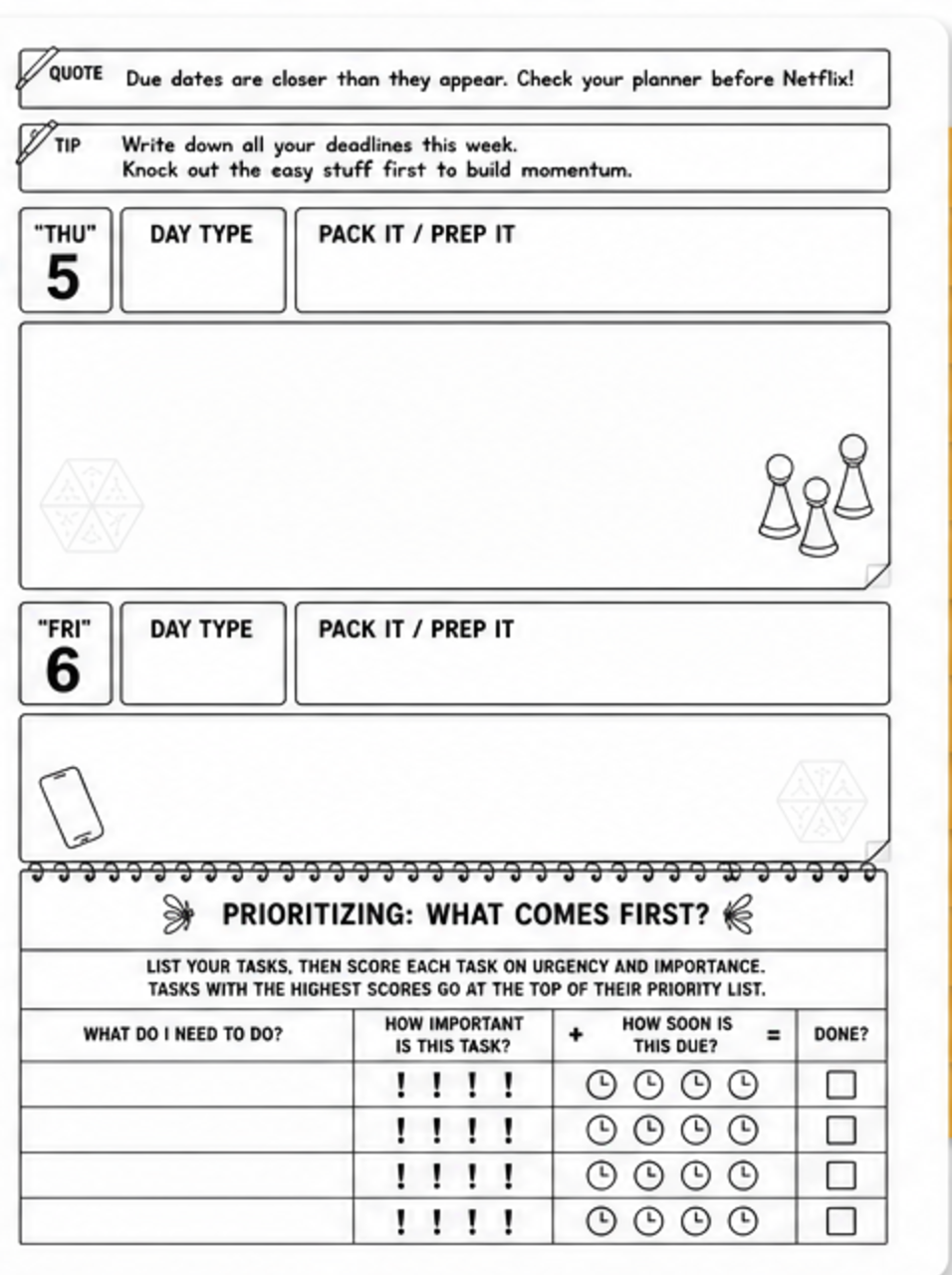
What a campus actually receives
Not a bulk order of notebooks. A curriculum, the instruction to deliver it, and the support to keep it running all year.
The same structure, 40 weeks running
The frame stays constant — day type for A/B and rotating schedules, Pack It / Prep It, daily capture — while the executive-function activity at the bottom of the spread changes every week: prioritizing one week, estimating time the next, then goal setting, task initiation and flexibility, before the cycle comes back around on new work.
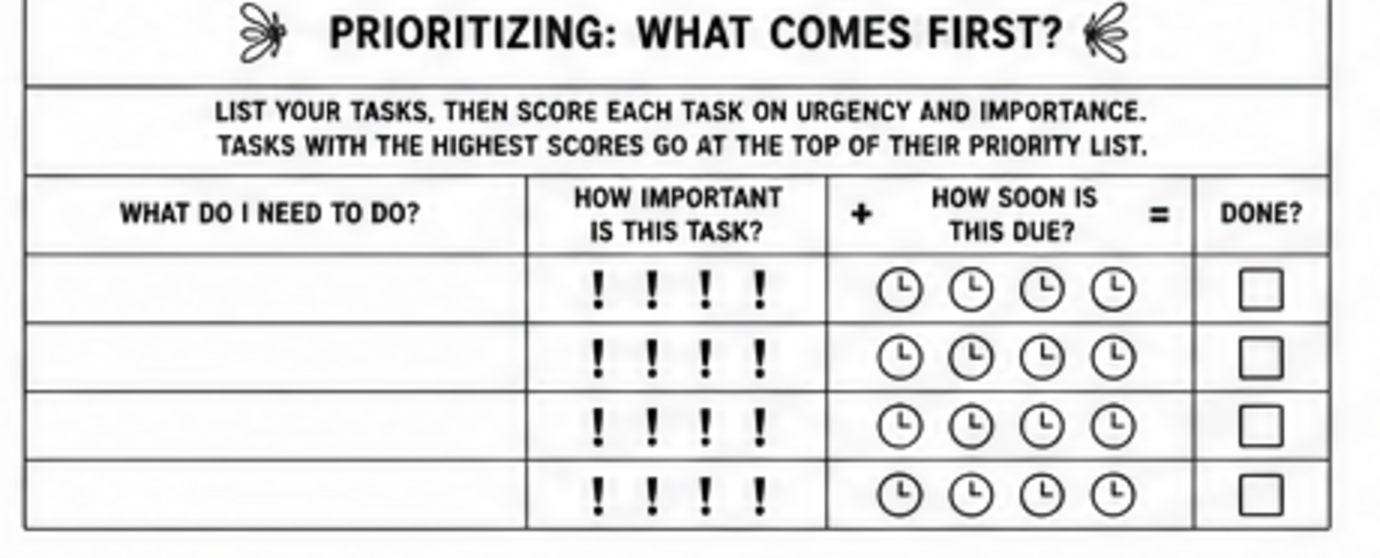
One week's activity, shown as an example: Prioritizing — “What Comes First?”
Your team sees it before the students do
Counselors and advisory teachers get Hub access: page-by-page walkthroughs, printable practice for any skill a student needs more reps on, and parent-facing companion pieces to send home.
A live session with Dr. Hill
A working call with your staff on rollout: which pages to use in advisory, how to run the small group, and what to say to families. Included with campus-scale orders.
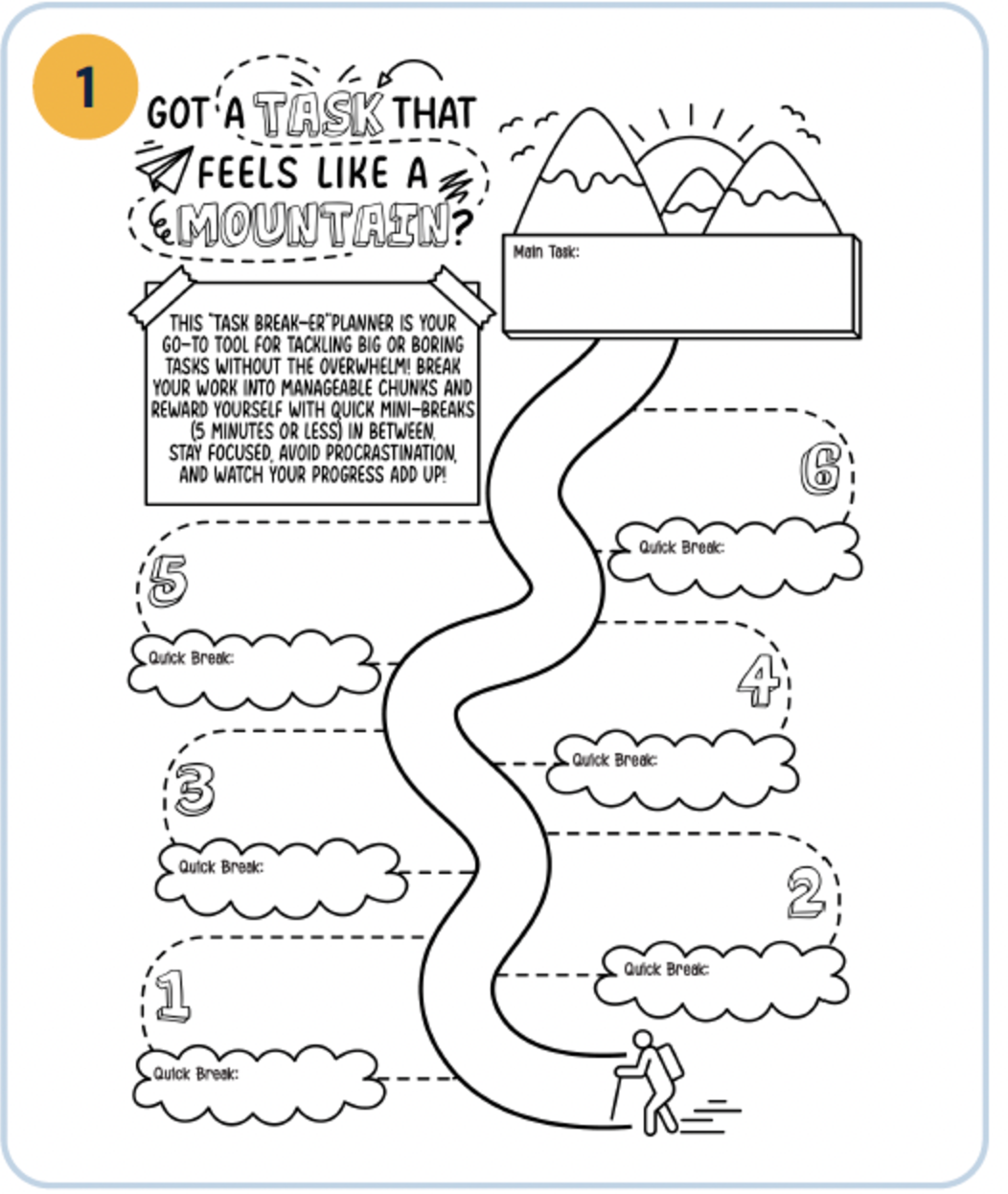 SPECIAL PLANNING PAGES
Task Break-er
Splits one overwhelming task into focused work segments with short breaks — the page for the student who cannot start.
 SPECIAL PLANNING PAGES
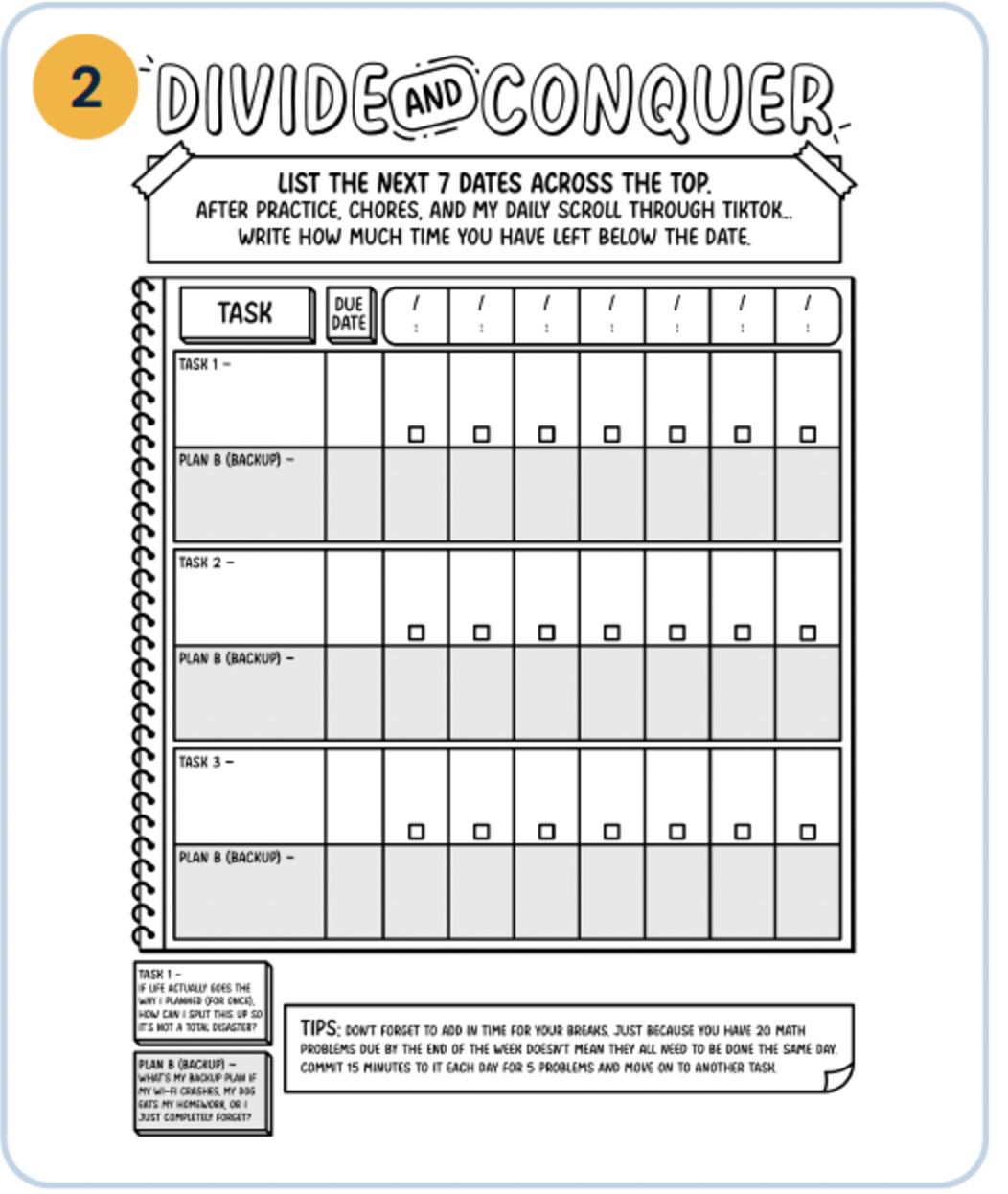
Divide & Conquer
Every task, due date and the next seven days in one view, plus a backup plan for the week that falls apart.
 SPECIAL PLANNING PAGES
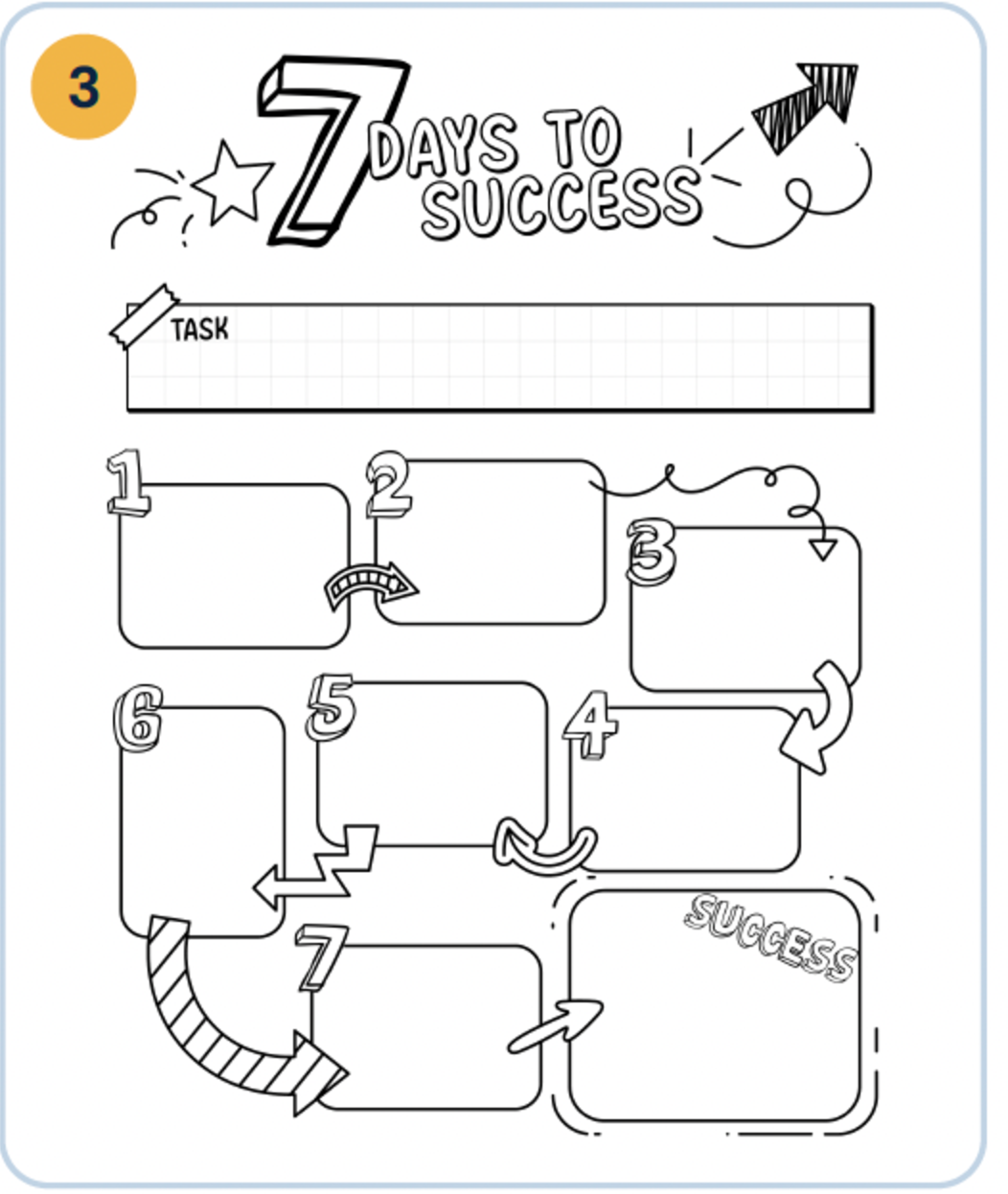
7 Days to Success
Sequences one goal into seven ordered steps — useful for credit recovery and goal-setting conferences.
“I absolutely love the Middle School Master Plan. I created a small group with this for students who struggle with procrastination, planning, or balancing school and extracurriculars.”
Middle School Counselor • Grand Prairie ISD, TX“The planner allowed students to organize assignments, school and home activities. I would highly recommend it for all students.”
Shaunne McKinley • Gifted Specialist, Deer Valley USD, AZMy son's school counselor called and asked what planner we were using. She'd noticed how organized he was and wanted to recommend it to other families. It was the Middle School Master Plan, still in testing.
Jennifer Hill, PhD • Founder
15+ years in education
Specialist in neurodiverse learners
Fifteen years in education, a doctorate, and a specialty in neurodiverse learners — including original research on twice-exceptionality that has been downloaded in 40 countries. This was built by an educator who has sat in the IEP meetings, not by a stationery company. Every structure follows peer-reviewed research on time-management planning, homework routines and self-regulated learning. That research informs the design; it is not an independent efficacy study of this product, and we don't present it as one.
Three reasons this is a campus decision, not a supply order.
The research below is about middle-grades systems, not about this product. It's the evidence base a campus can cite when it justifies putting executive-function instruction in front of every student.
Sixth grade is where the trajectory sets
Early-warning research identifies the middle grades as the point where behavioral self-regulation begins predicting later high school outcomes. Structural intervention here costs less than remediation later.
Balfanz, Herzog & Mac Iver (2007), Preventing Student Dropout: An Early Warning System for Middle Grades, Everyone Graduates Center, Johns Hopkins UniversityTier 1 reaches the students Tier 2 never flags
When executive-function support exists only as an individual accommodation, it reaches only students already identified. Universal, explicit EF scaffolding raises the floor for a whole grade level without singling anyone out.
Meltzer (2018), Executive Function in Education: From Theory to Practice, Guilford PressChasing missing work is a retention problem
Teachers consistently name non-instructional load — tracking missing work, managing disorganization, paper logistics — among the structural drivers of stress and attrition. A shared organizational system gives minutes back to instruction.
National Center for Education Statistics, Teacher Turnover: Stayers, Movers, and Leavers, U.S. Department of EducationThese studies describe middle-grades systems and executive-function instruction generally. They are context for the decision, not efficacy findings for The Middle School Master Plan.
If a system breaks down the same way every time, the user isn't the problem.
To the counselor or principal reading this,
For years I watched capable middle schoolers fall into the same pattern: they could see every deadline in the online portal, and still not turn the work in.
The standard response is to hand a student a blank calendar and tell them to prioritize. That's an impossible instruction. A traditional planner assumes executive function that an adolescent's prefrontal cortex is still building. We were giving students a place to record work and never showing them how to execute it.
So I built the thing I couldn't buy — at my kitchen table, self-funded, grounded in peer-reviewed cognitive science. Instead of worksheets a student fills out once and forgets, I built structures they use on their own work every week: a concrete priority equation, task-breaking brackets, strategic Plan B lines.
We don't teach executive function as its own subject. We embed it in the homework students already have, so the habit forms on real work.
My goal isn't to sell a million planners. It's to partner with the schools and counselors who are tired of the daily homework battle and want to coach adolescents into self-regulated, confident learners.
With appreciation,
Dr. Jenn
Funding sources other campuses have used
Your business office has the final word on eligibility. This is a starting list for that conversation, not a legal determination.
Language your business office will accept
“Requesting a Tier 2 executive-function intervention for students identified through late-work and failure reports. The materials provide explicit instruction in organization, task initiation, time management and self-advocacy, with documentable weekly practice aligned to 504 and IEP goals.”
Email us for a quote and W-9 — same dayThe Counselor 5-Pack
Five planners and five Hub seats — enough to run one small group for a full year. No purchase order, no committee, no campus adoption. Try it with the five students you're already worried about.
For verified school counselors and case managers.
The Classroom Pack
Thirty planners and a staff Hub license — one advisory section, one bell, one teacher. Enough to run the whole year with a real class instead of a pilot group, and small enough to clear most campus discretionary budgets without board approval.
More than one section? Ask for a grade-level quote.
Purchasing questions
How do we get a quote and a W-9?
Email [email protected] with quantity, grade levels and your delivery date. You'll get a formal quote and a W-9 the same day, in whatever format your business office needs.
Do you accept purchase orders?
Yes. Send the PO and we produce and ship against it; invoicing follows your district's terms. No credit card required.
Can we pilot it before adopting campus-wide?
That's the recommended path. Run a cohort — one counselor's small group or a single grade level — for a semester, look at the missing-work data for those students, and scale from evidence you collected yourself.
Can we see one before we buy?
Yes — request a sample planner to evaluate. Most counselors want to hold it and flip through the EF activities before bringing it to a team meeting.
How much training does staff need?
None to start — the instruction is printed on the page and the Hub videos speak directly to students. Campus orders include a live implementation session so your team knows which pages to use where.
Does it work for students with IEPs and 504 plans?
It was built with executive dysfunction in mind. It gives case managers concrete, repeated, documentable practice against goals that name organization, task initiation, time management or self-advocacy — using the student's real coursework, in the same book their classmates carry.
What's the deadline for fall delivery?
Order as early as you can — quantities for the 2026–27 edition are limited and campus orders are produced in the order received. Tell us your first day of school and we'll work backward.
You can’t add a period to the master schedule.
You can change what happens inside the one you already have.
Send the quantity and your first day of school. A quote comes back the same day.